

OEM Memory Foam Pillow Development: From Product Idea to Mass Production
Aug 13, 2026
Leave a message
Introduction
A buyer approaching a memory foam pillow factory for the first time may expect the process to be straightforward: send a picture, select a foam density, add a logo and request a quotation.
In practice, successful OEM development requires more decisions.
A pillow that looks simple from the outside may involve choices about foam formulation, firmness, dimensions, mold structure, cover construction, zipper position, fabric stretch, labels, compression, carton size and inspection standards. Changing one of these elements late in development can affect several others.
This is why experienced manufacturers treat OEM development as a sequence of connected decisions rather than a quotation exercise.
For importers, distributors, private label brands, Amazon sellers, hotel suppliers and retail chains, understanding this process can reduce unnecessary sampling, shorten communication cycles and make quotations from different factories easier to compare.
Our factory currently produces memory foam sleeping pillows, travel pillows, seat cushions, lumbar products and related products, with OEM/ODM customization covering areas such as appearance, labels and packaging.
The following is how a memory foam pillow project typically moves from an initial concept toward stable mass production.
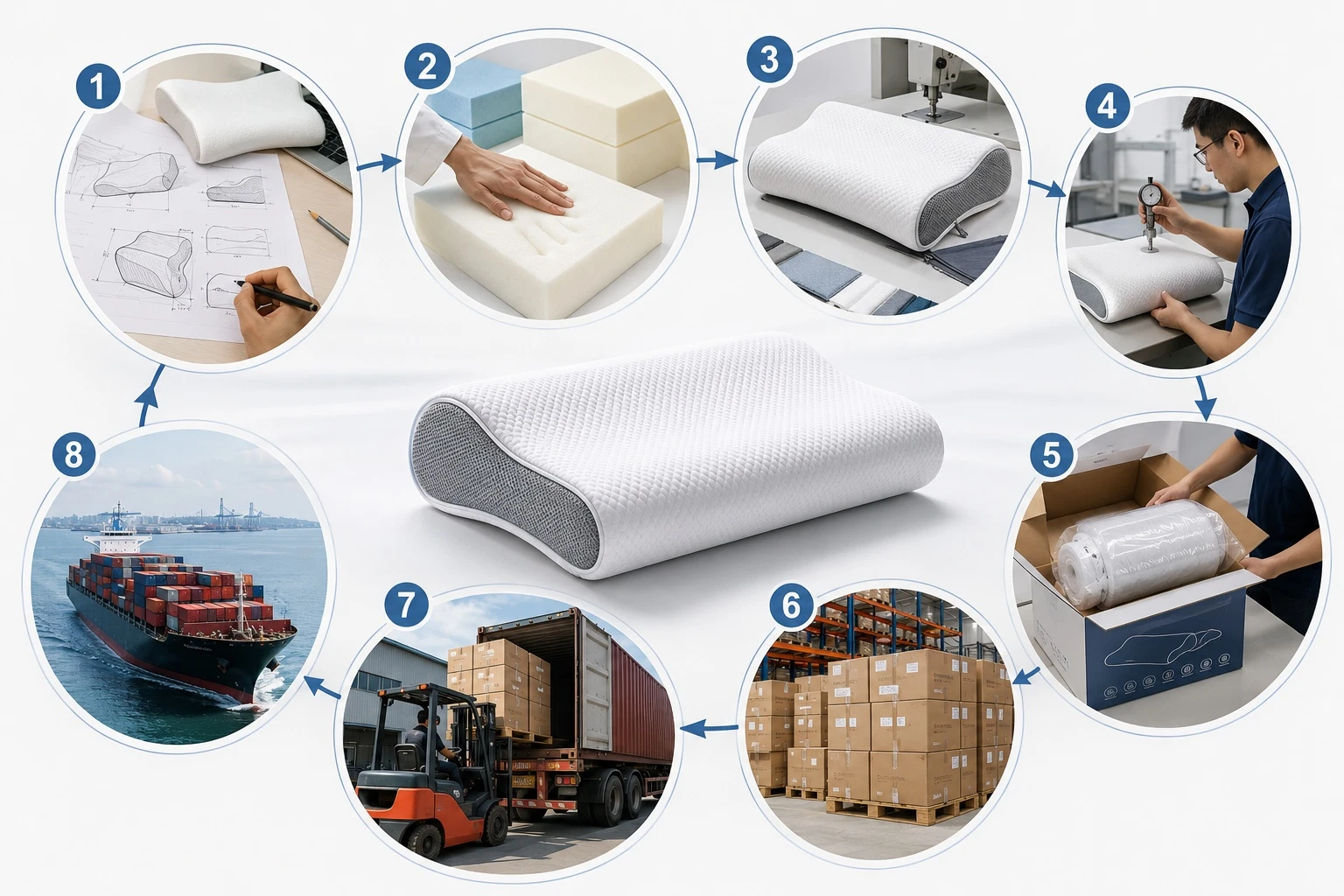
Main Content
1. Product Development Should Begin With the Market, Not the Mold
One of the most useful questions a manufacturer can ask at the beginning of an OEM project is not "What size do you need?"
It is:
Where will this product be sold, and who is expected to buy it?
The answer influences almost everything that follows.
A private label brand developing a premium cervical pillow for online retail has different requirements from a hotel supplier sourcing a standardized pillow for repeated bulk purchasing. An importer supplying discount retailers may prioritize cost control and carton efficiency, while an Amazon seller may place greater importance on differentiation, package dimensions and visual presentation.
Before creating a sample, we therefore need to understand several commercial points:
- Product category and intended use
- Target market
- Sales channel
- Expected price position
- Estimated order quantity
- Required customization
- Packaging method
- Target launch schedule
These details do not need to be perfect at the beginning. They provide the factory with a framework for making practical recommendations.
Consider two buyers requesting an "ergonomic memory foam pillow."
Buyer A wants an exclusive contour with different neck heights and a premium knitted cover. Buyer B wants to test demand with a smaller initial order and has no requirement for a proprietary shape.
Producing a new mold may make sense for Buyer A. For Buyer B, an existing structure with customized foam feel, fabric, color, logo and packaging may reduce development cost and lead time.
Both products can be OEM projects, but they should not follow the same development route.
This is also why sending only a competitor photograph is rarely enough for an accurate quotation. A photograph communicates appearance; it does not define the complete specification.
2. Foam, Structure and Cover Need to Be Developed Together
Once the commercial direction is clear, the project moves into technical specification.
For a molded memory foam pillow, three elements deserve particular attention: foam core, structural geometry and cover construction.
Foam specification
Density is important, but it should not be confused with firmness.
During development, the factory may need to consider density, hardness or feel, rebound characteristics and the dimensions of the finished core together.
A higher specification is not automatically the better specification. The objective is to match the foam to the product.
For example, a relatively simple sleeping pillow and a highly contoured cervical pillow can behave differently even when nominal foam specifications appear similar. Thin edges, raised support areas and deep contours change how the finished product responds under load.
Structural design
For an existing factory model, buyers can normally begin by evaluating a sample.
A completely custom structure requires more work.
Dimensions need to be clearly defined, especially where the design includes different heights or asymmetrical areas. If CAD drawings, 3D files or physical reference samples are available, they can make communication considerably more accurate than annotated photographs alone.
Before opening a production mold, the factory should evaluate whether the geometry is realistic for foam manufacturing.
An attractive 3D rendering does not always translate directly into an efficient foam structure. Extremely thin sections, abrupt transitions or complex undercuts may create manufacturing problems or increase defect risk.
Resolving those issues before tooling is cheaper than discovering them after a mold has been made.
Cover construction
The cover should not be treated as decoration added at the end.
Memory foam is three-dimensional and compressible. Fabric stretch, seam position, zipper length and sewing tolerance influence how well the cover fits the foam core.
A cover that is too loose can make the finished pillow look poorly constructed. A cover that is too tight can distort the intended contour.
For this reason, foam and cover samples should eventually be evaluated as one finished product.
3. Sampling Is Where Specifications Become Measurable
The purpose of an OEM sample is not simply to show the buyer something that looks good.
A useful sample converts the development discussion into a physical reference.
At this stage, buyers should evaluate more than initial comfort.
Depending on the product, sample approval may include:
- Finished dimensions
- Foam feel and recovery
- Contour accuracy
- Product weight
- Fabric appearance and hand feel
- Cover fit
- Sewing workmanship
- Zipper operation
- Logo size and position
- Label content
- Packaging configuration
- Recovery after compression
If multiple foam options are being considered, samples should be clearly identified. Otherwise, subjective feedback such as "make it slightly softer than the previous one" becomes difficult to manage after several development rounds.
A better process is to maintain a specification record for each version.
For example:
Sample A: existing mold + selected foam specification + polyester knitted cover.
Sample B: same mold + softer foam specification + same cover.
Now the buyer can compare one variable rather than two completely different products.
This sounds simple, but controlled sampling is one of the easiest ways to reduce confusion in OEM projects.
It also improves the transition into mass production because the approved sample can serve as a reference alongside written specifications.
4. Mass Production Requires Controls Beyond the Approved Sample
Sample approval is an important milestone, but it is not the end of product development.
The next challenge is reproducing the approved result consistently at production scale.
The factory's published pillow production process includes raw-material handling, foaming, foam QC, special-shape cutting, fabric cutting, sewing, shredded-foam filling where applicable, finished-product checking, packing and preparation for shipment.https://www.gzmemorypillow.com/memory-foam-pillow/
Different pillow constructions require different control points.
For molded foam, inspection may focus on:
- Foam appearance
- Dimensions
- Shape consistency
- Recovery characteristics
- Surface defects
For shredded foam products, filling weight and distribution become more important.
During sewing, the factory should monitor:
- Fabric consistency
- Seam workmanship
- Zipper installation
- Label position
- Cover dimensions
Final assembly introduces another practical check: whether the cover fits the foam correctly across production units rather than only on the original sample.
Quality control should therefore be connected to the approved specification.
"Good quality" is too broad to function as an inspection standard.
A buyer and manufacturer are better served by agreeing on measurable requirements wherever possible and using the approved sample for characteristics that are difficult to describe numerically.
For larger programs, especially repeat orders for distributors and retail chains, consistency between batches can be as important as the quality of the first shipment.
5. Packaging Should Be Developed Before Production Is Finalized
Packaging is often discussed too late.
For export memory foam products, this can be an expensive mistake because the packaging method affects carton volume, freight efficiency and sometimes the product itself.
Memory foam can often be compressed for shipment. However, the factory still needs to evaluate how the selected foam, pillow structure and cover respond to the proposed packing method.
A packaging trial should consider:
- Compression method
- Individual package dimensions
- Recovery after unpacking
- Retail presentation
- Inner packaging material
- Units per carton
- Master-carton dimensions
- Shipping marks
- Private label requirements
For an Amazon seller, package dimensions may directly affect fulfillment economics.
For a retail chain, shelf presentation and barcode placement may carry greater importance.
For an importer shipping mixed products in containers, carton dimensions need to work within a broader loading plan.
Hotel suppliers may prefer simpler packaging because products are distributed through a different supply chain.
There is therefore no single "best" package for an OEM memory foam pillow.
Packaging should support the buyer's channel.
This is one reason we recommend discussing packaging during sampling rather than after the purchase order has already been finalized.
Industry Insights
The role of an OEM memory foam manufacturer is gradually moving beyond basic contract production.
Global buyers increasingly expect factories to participate in product development: evaluating structures, recommending materials, adapting existing designs, developing covers and coordinating private label packaging.
This is particularly relevant for brands trying to differentiate products without building an entirely new supply chain for every SKU.
At the same time, more customization does not automatically create a stronger product.
A custom mold, special fabric, cooling layer, complex packaging and multiple accessories may all be technically possible, but each feature adds cost and another variable that needs to remain consistent during production.
Experienced product development therefore involves knowing what not to customize.
The strongest OEM projects usually concentrate investment on the features customers will actually recognize and value.
Buyer Considerations
Before requesting quotations from multiple memory foam manufacturers, buyers should prepare a specification brief that separates confirmed requirements from flexible ones.
Confirmed requirements might include product dimensions, target market, required logo method and packaging restrictions.
Flexible requirements could include foam density, fabric composition or certain structural details where the factory is expected to make recommendations.
This distinction is useful because it prevents suppliers from quoting fundamentally different products under the same inquiry.
Buyers should also compare quotations beyond unit price.
Ask what the quotation includes, whether new tooling is required, what packaging has been assumed, how customization affects MOQ, what sample stages are expected and which specifications will be used for production approval.
A lower initial quotation can become less competitive if important development or packaging requirements were excluded.
Factory Perspective
From a manufacturing perspective, the most efficient OEM projects are not necessarily those with the fewest custom requirements.
They are the projects where the important requirements are defined early.
Our factory history dates its own production facility to 2010; the current site describes a 10,000-square-meter factory, more than 20 large-scale production facilities, and customization covering logos, woven labels, packaging and appearance design.https://www.gzmemorypillow.com/about-us?utm_source=chatgpt.com
That manufacturing experience reinforces a practical lesson: changes become more expensive as a project moves closer to mass production.
Changing a label during sampling is relatively simple. Changing the shape after tooling is different. Changing the package after carton quantities and freight calculations have been confirmed can affect purchasing and logistics.
Good OEM management is therefore largely about making decisions in the correct order.
FAQ
What information should I send a memory foam pillow manufacturer for an OEM quotation?
Provide the product type, dimensions, reference images or drawings, target market, estimated quantity, foam requirements if already known, cover requirements, logo method and packaging expectations. If some specifications are undecided, identify them as areas where you want factory recommendations.
Do I need a custom mold for a private label memory foam pillow?
Not always. Private labeling can also be built around an existing foam structure with customized density or feel, cover fabric, colors, logo, labels and packaging. A custom mold is more appropriate when proprietary shape is an important part of the product strategy.
How should an OEM sample be approved?
Evaluate the complete product rather than appearance alone. Confirm dimensions, foam characteristics, cover fit, workmanship, branding and packaging. Keep the final approved sample and written specification as references for mass production.
When should packaging be confirmed?
Packaging development should begin during the sample stage. For compressed memory foam products, the factory should evaluate recovery and finished package dimensions before the mass-production packaging plan is locked.
Conclusion
Developing an OEM memory foam pillow is not a single manufacturing step. It is a chain of decisions connecting market positioning, foam specification, product structure, cover construction, sampling, quality control and packaging.
For B2B buyers, the most reliable approach is to define the commercial objective first and then develop the technical specification with the manufacturer.
Clear requirements at the beginning reduce unnecessary sample revisions. Controlled sample approval creates a stronger production reference. Construction-specific quality checks improve consistency, while early packaging development prevents avoidable logistics problems.
The goal of OEM development is not to customize every possible detail. It is to identify the details that create commercial value and build a production system capable of reproducing them consistently across the first order and the orders that follow.