

Molded vs Shredded Memory Foam Pillows: A Manufacturer’s Guide for OEM Buyers
Aug 10, 2026
Leave a message
Introduction
For a buyer developing a new memory foam pillow, choosing the foam density or cover fabric is only part of the specification. One decision made much earlier can change almost every stage that follows: should the pillow use a solid molded foam core or shredded memory foam filling?
At retail level, the difference may look simple. A molded pillow contains a defined foam core, while a shredded pillow uses smaller pieces of memory foam inside a fabric shell. At factory level, however, they are two different product-development routes.
They require different production processes, different quality-control points, different approaches to customization, and often different packaging strategies.
For importers, distributors and private label brands, the correct choice therefore depends less on which construction is "better" and more on what kind of SKU the business wants to build.
This guide looks at the decision from an OEM memory foam manufacturer's perspective.
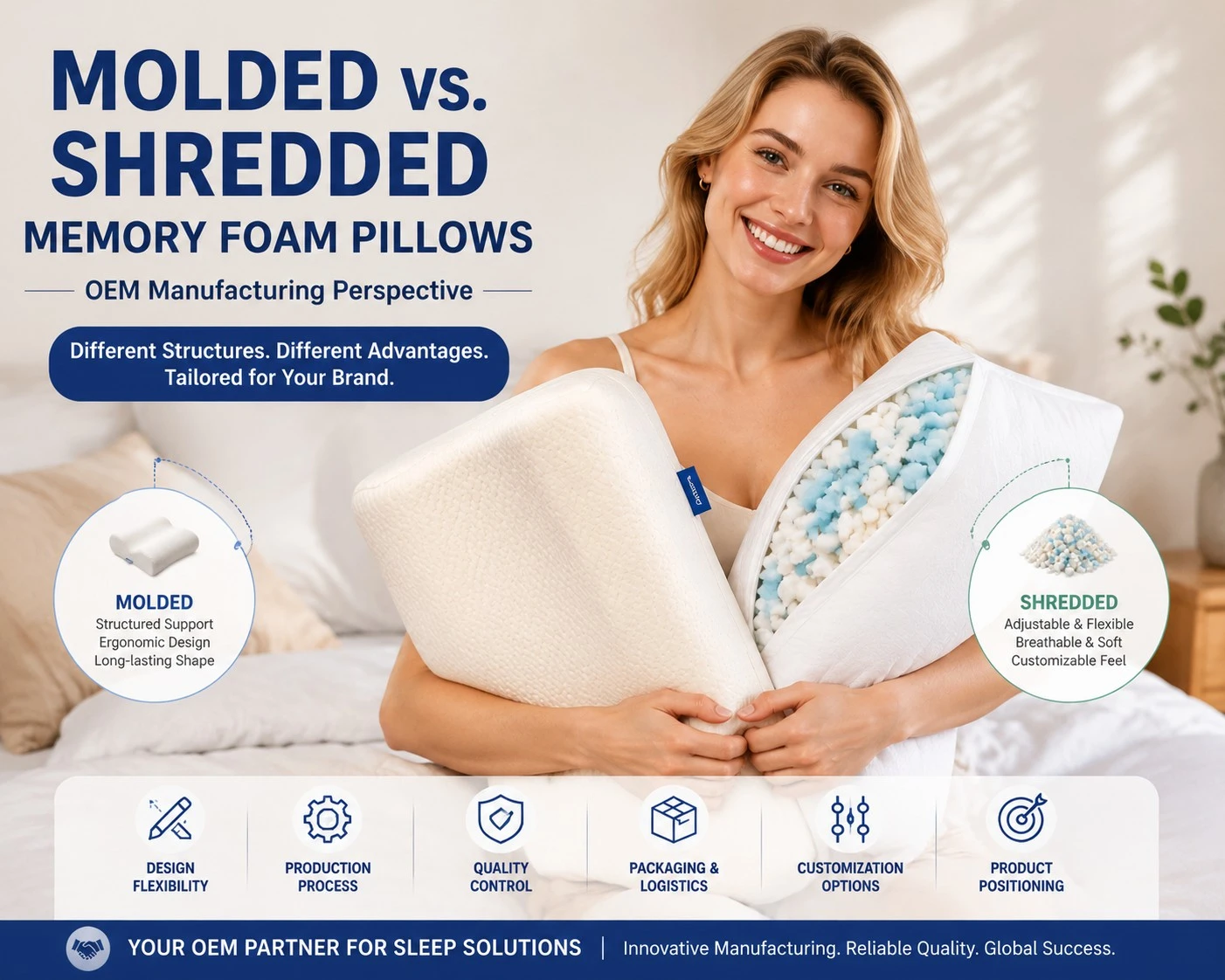
Molded and Shredded Foam Start With Different Product Logic
A molded memory foam pillow is built around a fixed three-dimensional structure. Once its dimensions, curves and support areas are established, the foam core determines much of the finished product's appearance and feel.
This construction is particularly useful when shape itself is part of the product concept.
A cervical pillow, for example, may require different neck heights, a central head area, shoulder curves or other defined contours. These features need to remain consistent from one unit to another.
Shredded memory foam works differently.
Instead of asking the foam core to create the complete geometry, smaller foam pieces are filled into an inner liner. The filling can move within that chamber, so the pillow is more adaptable. With a suitable zipper construction, brands can also create an adjustable-fill product that allows foam to be added or removed.
This leads to an important OEM distinction:
Molded foam is usually structure-driven; shredded foam is usually fill-driven.
That distinction affects nearly every later development decision.
How the Manufacturing Processes Differ
For molded products, development normally starts with dimensions and geometry.
If a buyer wants a custom ergonomic pillow rather than an existing factory model, the manufacturer first needs enough information to evaluate whether the shape is practical for production. Height transitions, narrow sections, deep curves and other structural details can affect molding and demolding.
After the shape is established, the foam specification must work with it.
A specification that performs well in a simple rectangular pillow does not automatically behave the same way in a highly contoured design. The manufacturer therefore needs to consider density, firmness, rebound and geometry together rather than approve each parameter separately.
The finished foam cores then require dimensional and appearance checks before moving into cover assembly and final inspection.
Shredded pillows introduce another set of controls.
The factory needs to manage the foam pieces themselves, the filling quantity and the distribution of filling inside the liner. A difference in fill weight can noticeably change loft and feel even when two pillows use the same outer dimensions.
The inner liner and zipper construction also become more important because they contain loose filling.
This means quality control moves away from checking only the dimensions of a solid core and toward controlling fill weight, fill consistency, sewing and assembly.
Which Construction Offers More Useful OEM Customization?
Both constructions are highly customizable, but they create different opportunities for a private label brand.
With molded foam, customization can concentrate on the physical architecture of the product:
- Overall length, width and height
- Contour profile
- Neck or shoulder areas
- Foam density and firmness
- Ventilation or surface structures
- Cover fabric and color
- Logo, label and packaging
This is valuable when a buyer wants the product itself to look recognizably different from generic pillows already on the market.
However, a new custom shape can involve more development work. Buyers should therefore decide early whether they genuinely need a proprietary structure or whether an existing mold with customized foam, fabric, branding and packaging can achieve the commercial objective.
Shredded foam offers another kind of flexibility.
The brand can adjust fill weight to influence loft and feel without redesigning an entire solid core. An accessible inner zipper can also create an adjustable pillow concept.
For Amazon sellers and private label brands, that feature can become part of the product proposition rather than merely a material specification.
But adjustability also adds components. Inner and outer covers, zipper quality, filling consistency and consumer instructions all need to be considered during development.
The best customization is not necessarily the product with the greatest number of features. It is the product whose features can be reproduced reliably in every production batch.
https://www.gzmemorypillow.com/memory-foam-pillow/
Quality Control Should Match the Construction
One mistake in sourcing is using the same QC checklist for every memory foam pillow.
For a molded pillow, we would pay particular attention to the foam core itself. Depending on the design, relevant checks can include dimensions, contour consistency, surface condition, foam response and fit between the core and cover.
This becomes especially important for ergonomic products. A visible difference in height or contour can affect both presentation and perceived consistency when products from the same order are placed side by side.
For shredded foam, weight control becomes more significant.
If filling varies from pillow to pillow, the customer may perceive different loft or firmness even though the fabric shell is identical. Sewing quality and zipper security also deserve additional attention because the construction contains loose material.
Packaging trials matter for both types.
Compression can reduce export volume, but a factory should not assume that the most aggressive compression ratio is automatically the most economical solution. Recovery after packing, presentation after opening, carton dimensions and the buyer's logistics requirements all need to be considered together.
For large orders, a packaging decision that saves a small amount per unit can have meaningful logistics value-but only if it does not create a product-consistency problem at destination.
How B2B Buyers Should Choose Between Them
The decision becomes easier when buyers start with the commercial objective rather than the material.
For an ergonomic cervical collection where recognizable contour design is a major selling point, molded memory foam usually provides greater control over the product's physical structure.
For a private label sleep pillow where adjustable loft is central to the concept, shredded memory foam may provide a more natural development route.
For hotel suppliers, consistency, replacement purchasing, housekeeping requirements and the target room category may matter more than consumer-facing adjustability.
Retail chains need to consider another factor: assortment architecture. If a retailer already carries conventional bed pillows, a distinctive molded contour pillow may occupy a clearer position in the range. Conversely, an adjustable shredded pillow may work when the retailer wants one SKU to accommodate a wider range of comfort preferences.
Amazon sellers also need to look beyond feature count. Packaging dimensions, product weight, differentiation, customer instructions and the likelihood of customers understanding the product immediately should all be considered before approving the final specification.
In practice, the right question is not:
"Is molded or shredded memory foam better?"
It is:
"Which construction gives this particular product the clearest market position while remaining stable to manufacture at the required volume and cost?"
Industry Insights
Memory foam pillow sourcing is gradually moving away from simple specification comparison.
Buyers increasingly want products that can be distinguished through structure, adjustability, cooling materials, covers, packaging or combinations of these features. That makes early product-development decisions more important.
At the same time, adding features without a clear commercial reason can make a pillow more expensive and more difficult to manufacture consistently.
For OEM development, the strongest projects usually begin with a defined market position and then work backward into construction, foam specification, cover and packaging-not the other way around.
FAQ
Is molded memory foam more expensive than shredded memory foam?
Not necessarily. Cost depends on foam formulation, product size, filling weight, cover construction, customization, packaging and order quantity. A custom molded design may involve additional development requirements, while a sophisticated adjustable shredded pillow can require extra fabric components and assembly.
Which type is better for a private label pillow?
It depends on the product concept. Molded foam is well suited to products differentiated by a fixed ergonomic structure, while shredded foam is useful when adjustable loft or a more adaptable feel is important.
Can the firmness of both types be customized?
Yes, but the development method differs. With molded foam, the manufacturer can work with foam formulation and core structure. With shredded products, the foam characteristics and quantity of filling both influence the finished feel.
What should buyers compare when approving samples?
Do not compare comfort alone. Check dimensions, weight, construction, cover fit, workmanship, recovery after packaging and consistency between multiple samples. The approved sample should function as a practical reference for mass-production expectations.