

Adjustable Memory Foam Pillow Development: How OEM Buyers Can Build a Customizable Pillow Range
Sep 14, 2026
Leave a message
Introduction
One of the challenges when developing a memory foam pillow is that a single height does not suit every market equally well.
Different sleeping positions, body proportions, mattress conditions and individual preferences can lead buyers to ask for several versions of the same pillow:
"Can we make this pillow higher?"
"Can customers remove one layer?"
"Can we offer soft and firm options without developing completely different products?"
This is where an adjustable memory foam pillow becomes commercially interesting.
Instead of relying on one fixed foam structure, an adjustable pillow allows the height, filling volume or internal construction to be changed. For private label brands and Amazon sellers, this can create a clearer product feature. For distributors and retail chains, it may also help one product platform cover a broader range of customer preferences.
However, adjustability adds manufacturing complexity.
The foam layers, dimensions, cover construction, fastening method and packaging all need to work together. If these elements are not defined correctly during sampling, an adjustable design can create more inconsistency rather than more flexibility.
For B2B buyers, the goal is therefore not simply to add removable foam. It is to develop an adjustable structure that is easy to understand, practical to manufacture and consistent across bulk production.
Main Content
1. There Is More Than One Way to Make a Pillow Adjustable
"Adjustable pillow" can describe several different constructions.
The first is a removable-layer design.
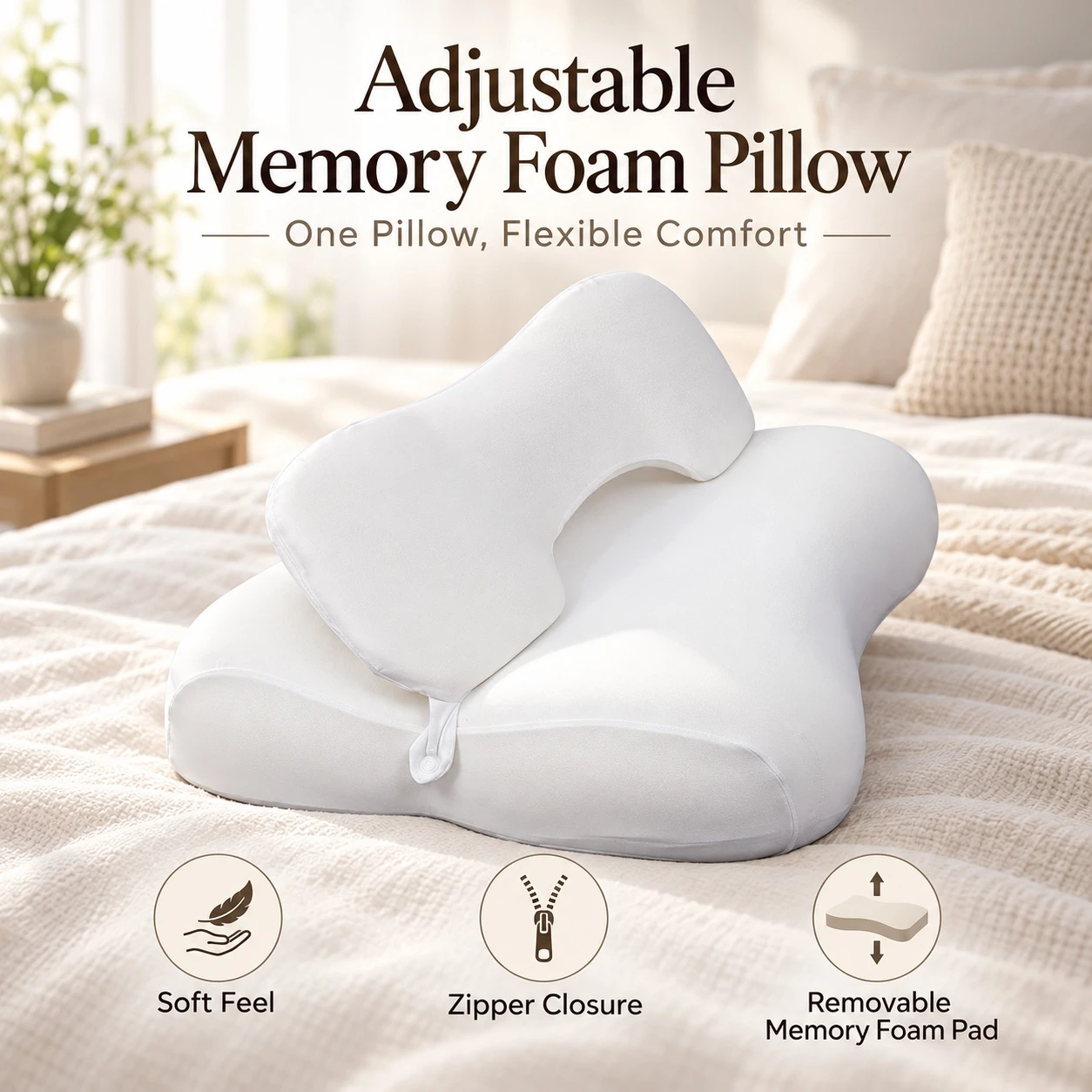
A molded memory foam pillow may contain a main ergonomic core plus one or more removable foam inserts. By adding, removing or repositioning these layers, the overall pillow height can be changed.
This construction is particularly useful when the external ergonomic contour needs to remain recognizable.
Another option is an adjustable shredded memory foam pillow.
Instead of removing complete layers, the user can add or remove shredded foam filling through an inner zipper. The amount of filling determines the loft and influences the feel of the finished pillow.
A third approach combines different foam components or reversible structures to create more than one configuration.
For an OEM buyer, these options should not be treated as interchangeable. Each construction creates different requirements for foam processing, covers, assembly, user instructions and quality control.
The correct choice depends on what the brand wants customers to adjust: height, loft, firmness perception, contour or a combination of these characteristics.
2. Adjustable Height Needs to Be Designed as a System
A removable layer sounds simple: add a piece of foam underneath the pillow and the product becomes higher.
In reality, the dimensions need to be calculated carefully.
Suppose the main pillow is 10 cm high and the removable layer adds another 2 cm. The buyer now effectively has two configurations:
10 cm - lower setting
12 cm - higher setting
But the manufacturer also needs to consider what happens to the cover in both configurations.
If the outer cover is designed tightly around the 12 cm version, it may become loose when the insert is removed. If it is designed around the lower configuration, the higher setting may create excessive fabric tension.
The shape of the insert matters as well.
A flat rectangular insert behaves differently from a layer that follows the ergonomic contour of the pillow. Button systems, zippers or internal positioning structures may be required to prevent removable components from moving inside the cover.
For this reason, adjustable height should be engineered as part of the complete pillow rather than added after the main foam mold has already been approved.
3. Adjustable Pillows Can Reduce the Need for Multiple Fixed-Height SKUs
From a B2B perspective, one of the most interesting aspects of adjustability is not simply comfort-it is SKU architecture.
Imagine a private label brand wants to sell a cervical pillow in three heights.
The traditional approach may involve three separate foam structures:
- Low
- Medium
- High
That can create additional inventory, packaging and forecasting requirements.
An adjustable structure may allow the brand to cover more than one height configuration within a single product.
This does not mean adjustable products always replace fixed-height pillows. Some markets still benefit from clearly separated sizes or support levels.
But for Amazon sellers and emerging private label brands, an adjustable design can provide a useful way to test broader customer preferences without immediately building a large SKU range.
Current B2B cervical-pillow sourcing content is also increasingly discussing high/low or adjustable configurations rather than assuming that one fixed height works universally.
4. Foam Firmness Still Matters
Adjustable height does not eliminate the need to choose the correct memory foam specification.
A buyer may assume that because customers can remove a layer, the foam firmness becomes less important.
It does not.
The main ergonomic core still determines much of the pillow's response under pressure.
The manufacturer needs to evaluate:
- Foam density
- Firmness
- Slow-rebound characteristics
- Main core thickness
- Insert thickness
- Contour geometry
- Finished pillow height
If the removable layer uses a different foam specification from the main core, that difference also needs to be intentional.
For example, an OEM project could theoretically use a firmer support layer underneath a softer ergonomic core. But this creates a different product from simply using two identical pieces of foam.
Buyers should therefore avoid approving individual foam pieces by hand and assuming the assembled pillow will feel the same.
The complete configuration needs to be sampled.
5. The Cover Becomes More Important in an Adjustable Design
An adjustable pillow usually contains more components than a conventional molded memory foam pillow.
That makes cover engineering more important.
Depending on the construction, the product may require:
- Outer removable cover
- Inner protective cover
- Zipper access
- Internal compartment
- Buttons or fastening points
- Elastic structures
- Separate insert cover
Fabric stretch also needs to accommodate the intended configurations.
For private label development, buyers can still customize fabric, colors, logos, woven labels and zipper details, but these decisions should be made around the adjustable structure.
A visually attractive cover is not useful if customers cannot easily access the removable layer.
Likewise, an oversized zipper may improve access but negatively affect the appearance of the finished pillow.
The manufacturer therefore needs to balance function, appearance and production efficiency.
Your current OEM/ODM manufacturing system already supports customization across memory foam type, product shape, fabric, private labeling and packaging, which provides a practical foundation for this type of multi-component pillow development.
6. User Instructions Become Part of the Product
With a conventional pillow, the customer usually removes the packaging and uses the product.
An adjustable pillow may require one additional step:
understanding how to adjust it.
This sounds minor, but it matters for private label products.
If a pillow contains a removable insert but the customer does not understand what it does, the feature loses much of its commercial value.
For e-commerce brands, the adjustment method can be demonstrated through product photography and listing graphics.
Retail products may need an insert card or packaging illustration explaining:
- Default configuration
- Lower configuration
- Higher configuration
- How to remove the insert
- How to reinstall it
- How to care for the cover
These instructions should be confirmed during packaging development rather than created after production has already started.
For private label brands, this is also an opportunity to make the product experience feel more complete.
7. Sampling Should Test Every Intended Configuration
An adjustable pillow should never be approved in only one configuration.
If the product has two heights, test both.
If it has three configurations, evaluate all three.
Buyers should check:
- Finished dimensions
- Height in each configuration
- Foam firmness
- Contour stability
- Insert positioning
- Cover fit
- Zipper operation
- Button or fastening security
- Sewing quality
- Appearance after adjustment
- Recovery after compression packaging
This becomes particularly important when the removable layer changes the tension of the outer cover.
A pillow may look excellent in its highest configuration but noticeably loose after an insert is removed.
Finding that problem during sampling is inexpensive.
Finding it after thousands of units have been produced is not.
The approved sample should therefore represent the complete adjustment system rather than just the main foam core.
8. Packaging Needs to Keep All Components Together
Adjustable pillows introduce another packaging consideration: multiple components must arrive as one complete product.
If the pillow includes a removable foam insert, inner cover, storage component or instruction card, the packing process needs to ensure that nothing is omitted.
Compression also needs to be tested with the assembled product.
Depending on the construction, manufacturers may pack the pillow with the insert already installed or position removable components differently before compression.
The final method should be confirmed through packaging trials.
For Amazon sellers, package dimensions remain important because additional foam layers can increase compressed volume.
For distributors and retail chains, packaging also needs to communicate why the adjustable construction justifies its position within the range.
This makes packaging both a logistics decision and a marketing decision.
Industry Insights
Adjustability is becoming an increasingly visible differentiation direction in the ergonomic pillow category.
A recent adjustable memory foam pillow reviewed in the UK market, for example, uses four removable layers to vary pillow height, illustrating how manufacturers and brands are moving beyond simple fixed-height structures.
At the same time, current manufacturer-facing product ranges increasingly position adjustable memory foam pillows alongside cervical, cooling and travel pillow categories, while OEM pages emphasize custom height and adjustable product directions.
For B2B buyers, this does not mean every new pillow should become adjustable.
The more useful takeaway is that personalization through product structure is becoming a stronger differentiation tool.
Instead of competing only through another fabric color or logo, brands can use removable layers, interchangeable components or adjustable fill to create a product feature customers can understand.
That creates opportunities for private label development-but only when the manufacturing structure remains manageable.
Buyer Considerations
Before requesting an adjustable memory foam pillow sample, buyers should define:
- Target market
- Main sleeping positions
- Minimum pillow height
- Maximum pillow height
- Number of adjustment levels
- Foam firmness preference
- Molded or shredded construction
- Cover material
- Adjustment mechanism
- Branding requirements
- Instruction requirements
- Packaging limitations
- Estimated order quantity
One particularly important question is:
Does the product genuinely need adjustability?
If the target market is already well defined and one height performs reliably, a fixed structure may remain simpler and more cost-effective.
If the brand wants one SKU to cover different preferences-or wants adjustability to become part of the product proposition-the additional development may be justified.
Factory Perspective
From a manufacturing perspective, adjustable pillows are attractive because they create meaningful product differentiation without necessarily requiring a completely different technology.
But they also introduce more control points.
A conventional molded pillow may involve one foam core and one cover. An adjustable design can involve several foam components, multiple covers, fastening systems and additional assembly steps.
Every component needs a specification.
Every component also needs to remain consistent when the order is repeated.
This is why the development process should move from structure to foam, then cover, adjustment mechanism and packaging-in that order.
As a memory foam manufacturer supporting OEM and ODM projects, the objective is not simply to demonstrate how many configurations can be created. It is to identify the smallest number of configurations that gives the buyer meaningful market differentiation while remaining practical for production.
FAQ
What is an adjustable memory foam pillow?
An adjustable memory foam pillow allows part of its height, loft or internal construction to be changed. Common designs use removable foam layers or adjustable shredded memory foam filling.
Can pillow height be customized for private label projects?
Yes. Height can be developed through the main foam structure, removable inserts or other adjustable constructions depending on the product concept.
Is an adjustable pillow better than a fixed-height pillow?
Not necessarily. Adjustable designs provide flexibility but require more components and manufacturing control. Fixed-height products may be more suitable when the target customer and preferred pillow specification are already clearly defined.
Can an adjustable pillow use an ergonomic cervical shape?
Yes. A molded ergonomic core can be combined with removable layers or other height-adjustment structures. The contour, insert and cover should be developed together.
What should buyers test before mass production?
Buyers should evaluate every intended configuration, including height, foam feel, cover fit, insert stability, adjustment mechanism and recovery after packaging.
Conclusion
Adjustable memory foam pillows provide B2B buyers with a different way to approach product differentiation.
Instead of developing several completely separate fixed-height pillows, a brand may use removable layers, adjustable filling or modular foam structures to offer more than one configuration within a single product.
But adjustability should not be added simply because it is becoming more visible in the market.
The structure needs to solve a clear product or merchandising problem.
For OEM buyers, that means defining the target height range first, then developing the foam core, removable components, cover and packaging as one complete system.
When those elements are controlled properly, an adjustable pillow can become more than another feature on the specification sheet. It can provide a recognizable product proposition while allowing the manufacturer to maintain a repeatable specification for bulk and future orders.
For buyers considering an adjustable, cervical or other custom memory foam pillow project, the product structure should therefore be confirmed during sampling before branding and packaging are finalized.https://www.gzmemorypillow.com/contact-us