

Memory Foam Lumbar Support Pillow Development: What OEM Buyers Should Define Before Sampling
Sep 07, 2026
Leave a message
Introduction
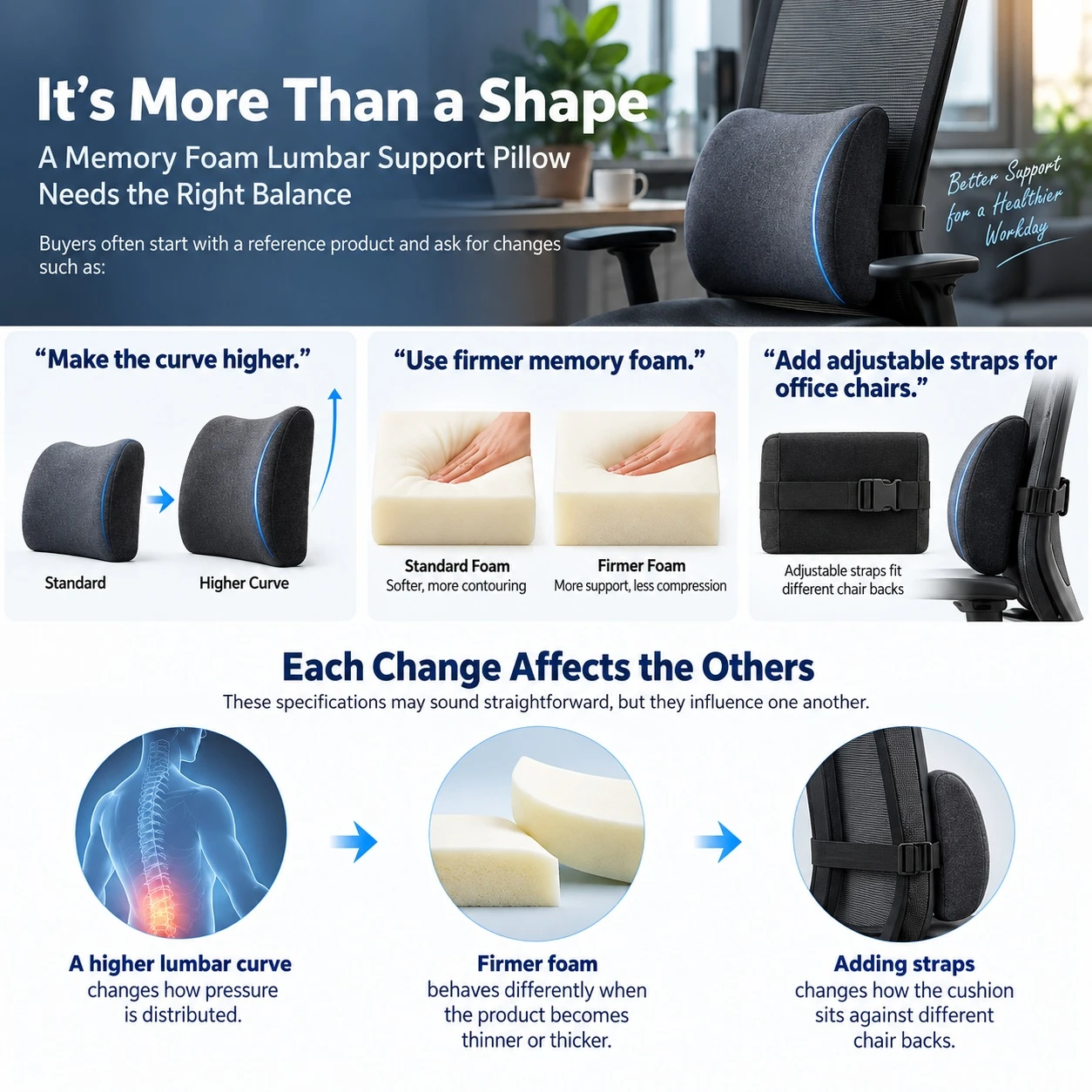
When developing a memory foam lumbar support pillow, buyers often begin with a reference product and ask for changes such as:
"Make the curve higher."
"Use firmer memory foam."
"Add adjustable straps for office chairs."
Each request sounds straightforward, but these specifications influence one another.
A higher lumbar curve changes how pressure is distributed. Firmer foam behaves differently when the product becomes thinner or thicker. Adding straps changes how the cushion sits against different chair backs.
For an OEM project, the goal is therefore not simply to reproduce an attractive ergonomic shape. The manufacturer needs to understand where the product will be used, how the foam and structure work together, and whether the design can be produced consistently in bulk.
For importers, private label brands and distributors developing memory foam lumbar support products, defining these requirements before sampling can significantly reduce unnecessary revisions.
Main Content
1. Start With the Intended Seating Environment
A lumbar support pillow may be used in:
- Office chairs
- Home-office chairs
- Gaming chairs
- Car seats
- Travel seating
- General home seating
These environments have different dimensions and backrest structures.
An office chair may provide a relatively wide and upright backrest, while a car seat usually has more pronounced side contours. A lumbar pillow designed around one environment may therefore not fit another equally well.
Before developing the shape, buyers should define the primary application.
This is particularly important for brands that want to advertise one product for office, home and automotive use. A universal design is possible, but the manufacturer needs to consider dimensions, strap length and contour carefully.
Your existing Memory Foam Lumbar Support Cushion is an example of a product developed around ergonomic back support, with customization available for color, logo, packaging and foam specifications.
For an OEM buyer, however, the important question is not whether a product can be customized. It is which customization actually improves the SKU for its intended market.
2. Lumbar Curve, Thickness and Foam Firmness Must Work Together
The shape is one of the most recognizable features of a lumbar support pillow.
Many designs use a curved or raised central area intended to follow the lower-back region. But increasing that curve without considering foam characteristics can create a completely different product experience.
Imagine two lumbar pillows with the same external dimensions.
One uses relatively soft foam.
The other uses a firmer formulation.
The second product may maintain its contour more strongly under pressure even though the CAD drawing is identical.
Thickness creates another variable.
A thin section of memory foam behaves differently under load from a thick section. This means foam density and firmness should not be approved separately from the final geometry.
During development, we normally consider:
- Overall width and height
- Maximum lumbar thickness
- Edge thickness
- Curvature
- Foam density
- Foam firmness
- Rebound characteristics
The objective is to create a balanced structure rather than simply making the center as thick or firm as possible.
This same principle applies to other ergonomic products. Your office backrest cushion range demonstrates how back-support products can use different structures depending on the intended application.
3. Straps and Covers Are Functional Specifications
For lumbar pillows, the cover and fastening system should be discussed during product development rather than added after the foam core is finalized.
A common requirement is an adjustable strap that holds the cushion against a chair.
The manufacturer needs to consider:
- Strap position
- Strap length
- Elasticity
- Buckle type
- Stitching strength
- Target chair dimensions
A strap that works well on a narrow office chair may not extend far enough around a larger gaming chair. An excessively long strap, meanwhile, can affect the appearance and usability of the product.
Some designs use one strap, while others use two to improve positioning.
The cover also influences the finished product.
OEM options can include breathable knitted fabrics, mesh panels, cooling textiles and other materials. A removable zipper cover is useful when the brand wants the outer fabric to be washable.
For higher-positioned products, brands may also combine memory foam with cooling features. For example, your existing Gel Cooling Memory Foam Back Cushion uses a gel-and-memory-foam structure aimed at ergonomic seating applications.
These features can create meaningful differentiation, but they also add material and assembly requirements. They should be introduced because they support the product strategy-not simply because they appear on competing listings.
4. Sampling Should Reproduce the Complete Product
A foam core alone is not enough to approve a lumbar support pillow.
The final sample should include the intended:
- Foam
- Cover
- Straps
- Buckles
- Logo
- Labels
- Packaging
This allows the buyer to evaluate the product in the same form customers will receive it.
During sample approval, important checkpoints include:
- Finished dimensions
- Lumbar contour
- Foam feel
- Shape recovery
- Cover fit
- Sewing quality
- Strap position
- Buckle operation
- Logo placement
- Appearance after packaging
If the product will be sold for several seating environments, buyers should also test the sample on representative chairs rather than evaluating it only by hand.
This is especially relevant for Amazon sellers and private label brands. A product may look correct in photography but perform differently when fitted to an actual chair.
The approved sample should then be retained as a physical reference for mass production.
5. Packaging Needs to Balance Freight Efficiency and Recovery
Memory foam lumbar pillows occupy significant volume relative to their weight, so compression packaging is often considered for export orders.
Reducing package volume can improve carton utilization and logistics efficiency. However, the manufacturer should test the actual finished product before finalizing the compression method.
The factory needs to evaluate:
- Foam recovery
- Contour recovery
- Cover appearance
- Strap and buckle position
- Individual package dimensions
- Units per master carton
For e-commerce sellers, package dimensions may influence fulfillment economics.
For distributors, carton efficiency and container loading may be more important.
For retail chains, the package also needs to communicate the product clearly to customers.
Packaging is therefore part of the OEM development process, not merely the final step before shipment.
Industry Insights
The ergonomic seating category is expanding beyond basic seat cushions.
Brands increasingly develop coordinated products such as lumbar pillows, coccyx cushions, footrests and other office-comfort accessories.
This creates an opportunity for distributors and private label brands to build product families rather than sourcing isolated SKUs.
For example, a buyer developing a lumbar support pillow may later extend the collection with a seat cushion using related fabric, branding and packaging.
This type of product-family strategy can create stronger visual consistency while allowing the manufacturer to reuse established materials and production standards.
The factory's broader OEM & ODM memory foam manufacturing service currently covers pillows, backrests, seat cushions and other ergonomic memory foam products, including customization of product shape, materials, branding and packaging.
Buyer Considerations
Before requesting an OEM lumbar pillow sample, buyers should ideally define:
- Primary seating application
- Target market
- Target retail price
- Product dimensions
- Preferred lumbar curve
- Foam feel
- Cover material
- Strap requirements
- Branding method
- Packaging restrictions
- Estimated order quantity
If some specifications are still undecided, identify them as flexible.
For example, a buyer may require a specific external shape but allow the factory to recommend two foam firmness options.
This makes sampling more controlled and prevents unnecessary changes to multiple variables at the same time.
Factory Perspective
From a manufacturing perspective, lumbar support products need to be evaluated as complete seating accessories rather than simple pieces of shaped foam.
Foam formulation, thickness, contour, fabric tension and fastening systems all affect the finished product.
This is also where manufacturing experience becomes valuable. According to our factory information, Jibei has operated its own factory since 2010 and currently produces memory foam pillows, neck pillows, cushions, lumbar products and other support products, with customization covering areas such as appearance, labels and packaging.
For a buyer entering the lumbar-support category, an existing structure with customized foam, fabric, logo and packaging can provide a relatively efficient starting point.
For established brands seeking stronger differentiation, custom contour development may be justified.
The correct approach depends on the market objective and expected order volume.
FAQ
Can the shape of a memory foam lumbar pillow be customized?
Yes. Width, height, thickness and contour can be adjusted for OEM projects. Completely new structures may require additional development or tooling depending on the design.
What foam firmness is best for a lumbar support pillow?
There is no universal specification. Firmness should be evaluated together with product thickness, contour and intended seating environment. Finished samples are more useful for approval than foam numbers alone.
Can straps, fabrics and logos be customized?
Yes. OEM lumbar products can use different cover materials, strap structures, colors, logos, labels and packaging depending on project requirements.
Should the sample be tested on actual chairs?
Yes. If the product is intended for office, automotive or gaming-chair applications, testing it in representative seating environments helps verify fit, strap length and overall positioning before mass production.
Conclusion
Developing a memory foam lumbar support pillow involves more than selecting an ergonomic curve and adding a strap.
The seating environment, contour, foam density, firmness, thickness, cover construction and fastening system all influence the finished product. Packaging also needs to preserve the structure while meeting the buyer's logistics requirements.
For B2B buyers, the most efficient OEM process is to define the application first, then develop the structure and materials around that commercial objective.
By approving the complete product-including the foam, cover, straps and packaging-buyers create a clearer reference for bulk production and reduce the risk of inconsistencies in repeat orders.
For brands planning a new lumbar support or ergonomic seating range, the next step is to discuss the target market and product requirements with the memory foam OEM development team before finalizing the sample specification.