

OEM Memory Foam Pillow Solutions: A Practical Guide For Global Brands
Jul 27, 2026
Leave a message
Introduction
For brands entering the sleep products market, developing a unique memory foam pillow line requires more than selecting an existing product from a catalog.
Today's customers expect products with distinctive designs, comfortable materials, reliable quality, and strong brand identity. For importers, retailers, and private label companies, working with an experienced OEM memory foam pillow manufacturer provides the flexibility needed to create products that match specific market requirements.
OEM manufacturing allows brands to customize pillow designs, foam specifications, cover materials, packaging, and branding elements while benefiting from the production experience of a professional factory.
A reliable OEM partner does not simply manufacture products according to drawings. The manufacturer should also understand material characteristics, production feasibility, quality requirements, and market trends to help customers develop competitive products.
This article explains how OEM memory foam pillow solutions work and what global buyers should consider when choosing a manufacturing partner.
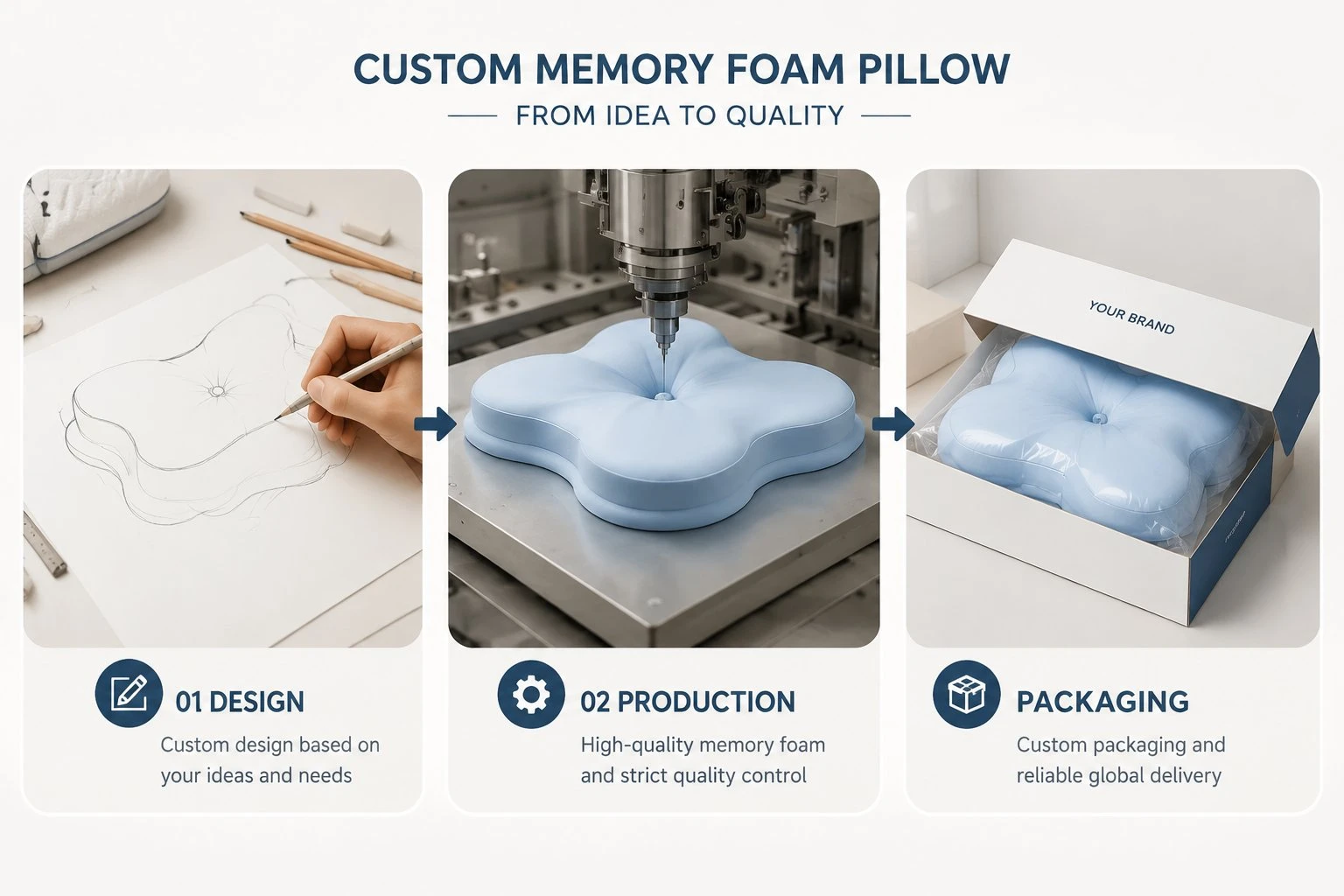
Main Content
1. What Is OEM Memory Foam Pillow Manufacturing?
OEM (Original Equipment Manufacturing) means a manufacturer produces products according to a customer's requirements while the customer sells the products under their own brand.
In the memory foam pillow industry, OEM cooperation usually includes:
- Custom pillow designs
- Customized foam specifications
- Private label branding
- Customized fabric covers
- Packaging solutions
- Product documentation
For brands, OEM manufacturing provides an efficient way to enter or expand within the sleep products market without investing in their own production facilities.
Instead of managing every production step internally, brands can cooperate with a professional memory foam factory that already has experience in:
- Foam processing
- Pillow development
- Sewing production
- Quality inspection
- Export packaging
This allows companies to focus more on marketing, distribution, and customer development.
2. Product Development Process For OEM Memory Foam Pillows
A professional OEM project usually begins with product development.
The process normally includes several stages.
Market Requirement Analysis
Before production starts, manufacturers need to understand:
- Target market
- Customer group
- Product positioning
- Expected price range
- Sales channel
For example:
- A premium bedding brand may require:
- High-quality fabric covers
- Advanced ergonomic designs
- Premium packaging
An e-commerce brand may focus on:
- Attractive appearance
- Competitive pricing
- Efficient packaging
Understanding the market direction helps manufacturers recommend suitable solutions.
Product Design And Prototype Development
Based on customer requirements, manufacturers develop the product structure.
This may include:
- Pillow shape
- Height design
- Support zones
- Foam structure
- Cover design
For ergonomic memory foam pillows, design details are especially important.
Examples include:
- Contour curves for cervical support
- Shoulder grooves for side sleepers
- Different height options
- Multi-layer foam structures
During OEM development, manufacturers often create samples for customers to evaluate before bulk production.
Sample development helps confirm:
- Product appearance
- Comfort level
- Dimensions
- Material selection
3. Customization Options For Private Label Brands
One of the biggest advantages of OEM memory foam pillow manufacturing is customization.
Custom Pillow Shape
Brands can develop different pillow structures based on their target customers.
Common customized designs include:
- Cervical pillows
- Butterfly pillows
- Travel neck pillows
- Contour pillows
- Adjustable pillows
Different shapes allow brands to create product differentiation instead of competing only on price.
Custom Memory Foam Specifications
Foam selection has a major impact on product performance.
Manufacturers can adjust:
- Foam density
- Firmness level
- Layer structure
- Recovery characteristics
For example:
A premium pillow collection may use higher-density foam for durability and support.
A travel pillow product may require lightweight foam with better portability.
The right foam specification depends on product positioning and customer expectations.
Custom Pillow Covers
The outer cover is an important part of both product performance and brand presentation.
OEM options may include:
- Fabric selection
- Color customization
- Logo labels
- Zipper designs
Washable cover options
Common materials include:
- Polyester blends
- Bamboo fabric
- Cooling fabrics
- Knitted fabrics
A well-designed cover can improve user experience while strengthening brand recognition.
Custom Packaging
Packaging plays an important role, especially for online retail brands.
OEM packaging options include:
- Custom boxes
- Printed cartons
- Product labels
- Instruction cards
- Vacuum compression packaging
For international shipping, vacuum packaging is commonly used because it reduces shipping volume and improves logistics efficiency.
4. Choosing The Right OEM Memory Foam Pillow Manufacturer
Not every supplier can provide the same level of OEM support.
Before cooperation, buyers should evaluate several important factors.
Manufacturing Experience
A capable manufacturer should understand:
- Memory foam characteristics
- Pillow structure design
- Production requirements
- International market expectations
Experience helps avoid common problems during development, such as:
- Incorrect foam selection
- Unstable product quality
- Difficult production processes
Production Capability
A professional memory foam pillow factory should have complete production processes, including:
- Foam cutting or molding
- Cover production
- Sewing
- Assembly
- Inspection
- Packaging
Stable production capability ensures consistent quality during bulk orders.
Quality Control System
Quality control is essential for private label products because the product represents the buyer's brand.
Manufacturers should monitor:
Raw Materials
Including:
- Foam quality
- Fabric materials
- Accessories
Production Process
Including:
- Size accuracy
- Sewing quality
- Product consistency
Finished Products
Including:
- Appearance inspection
- Packaging inspection
- Final product checks
A reliable OEM supplier should have clear quality procedures throughout production rather than only checking finished products.
5. OEM vs ODM: Understanding The Difference
Many buyers compare OEM and ODM services when developing new products.
OEM Manufacturing
OEM is suitable when buyers already have:
- Product concepts
- Design requirements
- Brand positioning
The manufacturer focuses on production according to customer specifications.
ODM Manufacturing
ODM provides more development support.
Manufacturers may assist with:
- Product design suggestions
- Structure improvements
- Material recommendations
- Prototype development
For brands without strong product development teams, ODM cooperation can shorten the development process.
Industry Insights
Growing Demand For Customized Sleep Products
The global sleep products market continues to move toward personalization and differentiated designs.
Consumers increasingly look for products that match specific needs, including:
- Ergonomic designs
- Cooling features
- Adjustable structures
- Premium materials
For brands, customized memory foam pillows provide opportunities to create unique product lines instead of selling generic products.
OEM Manufacturing Helps Brands Build Long-Term Product Lines
A successful OEM partnership is not only about producing one product.
Many brands gradually expand their product range from:
- Memory foam pillows
to:
- Travel pillows
- Lumbar support pillows
- Seat cushions
- Other memory foam accessories
Working with a manufacturer that understands multiple product categories allows brands to develop a more complete product portfolio.
Buyer Considerations
Before selecting an OEM memory foam pillow supplier, buyers should prepare several key questions:
About Product Development
Can the supplier customize existing designs?
Can they develop new pillow structures?
Can they provide samples before production?
About Materials
- What foam specifications are available?
- Can different comfort levels be developed?
- What cover materials can be customized?
About Production
- What is the minimum order quantity?
- What is the production lead time?
- How is quality controlled?
About Export Experience
- Has the supplier worked with international customers?
- Can they support export packaging requirements?
- Can they provide necessary product documents?
Clear communication before production helps create smoother cooperation.
Factory Perspective
From a manufacturer's perspective, successful OEM projects require close cooperation between buyers and production teams.
A good OEM process is not simply:
Customer provides order → Factory produces → Goods are shipped
Instead, successful cooperation usually involves:
Customer requirements
↓
Product discussion
↓
Material selection
↓
Sample development
↓
Testing and adjustment
↓
Mass production
↓
Quality inspection
↓
Final shipment
Each step affects the final product quality.
For memory foam products, small changes in foam density, pillow height, fabric structure, or packaging method can influence the final customer experience.
Therefore, choosing a manufacturer with practical production experience is important for building reliable products.
FAQ
What is an OEM memory foam pillow?
An OEM memory foam pillow is a product manufactured according to a brand's requirements, including design, materials, specifications, and packaging, while being sold under the customer's brand.
Can OEM manufacturers customize pillow designs?
Yes. OEM manufacturers can customize pillow shapes, foam specifications, covers, labels, and packaging based on customer requirements.
What is the difference between OEM and ODM pillows?
OEM focuses on producing according to customer designs, while ODM includes additional product development support from the manufacturer.
How long does OEM memory foam pillow development take?
Development time depends on product complexity, sample requirements, materials, and customization details.
Why should brands work with a memory foam pillow manufacturer in China?
China has mature memory foam production supply chains, experienced factories, flexible customization options, and strong manufacturing capabilities for international brands.
Conclusion
OEM memory foam pillow manufacturing provides global brands with an effective way to develop customized sleep products without building their own production facilities.
The right manufacturing partner can support the entire process, from product design and material selection to quality control and final production.
For importers, retailers, and private label brands, choosing an experienced memory foam pillow manufacturer is an important step toward creating competitive products and building long-term market value.