

Memory Foam Pillow Certifications: What OEM Buyers Should Verify Before Placing an Order
Sep 17, 2026
Leave a message
Introduction
When sourcing memory foam pillows, buyers often ask a factory a short question:
"Do you have certifications?"
It is an important question, but it is usually not specific enough.
A supplier may send several certificates and laboratory reports, yet those documents do not automatically apply to every pillow the factory produces. One certificate may relate specifically to polyurethane foam. Another may cover a particular fabric. A test report may have been issued for a different material specification from the one being quoted.
For importers, distributors and private label brands, the more useful question is:
"Which document applies to the exact material and product specification we are ordering?"
This distinction becomes increasingly important when products are sold through retail chains, e-commerce platforms or other channels where buyers may need supporting documentation for product claims.
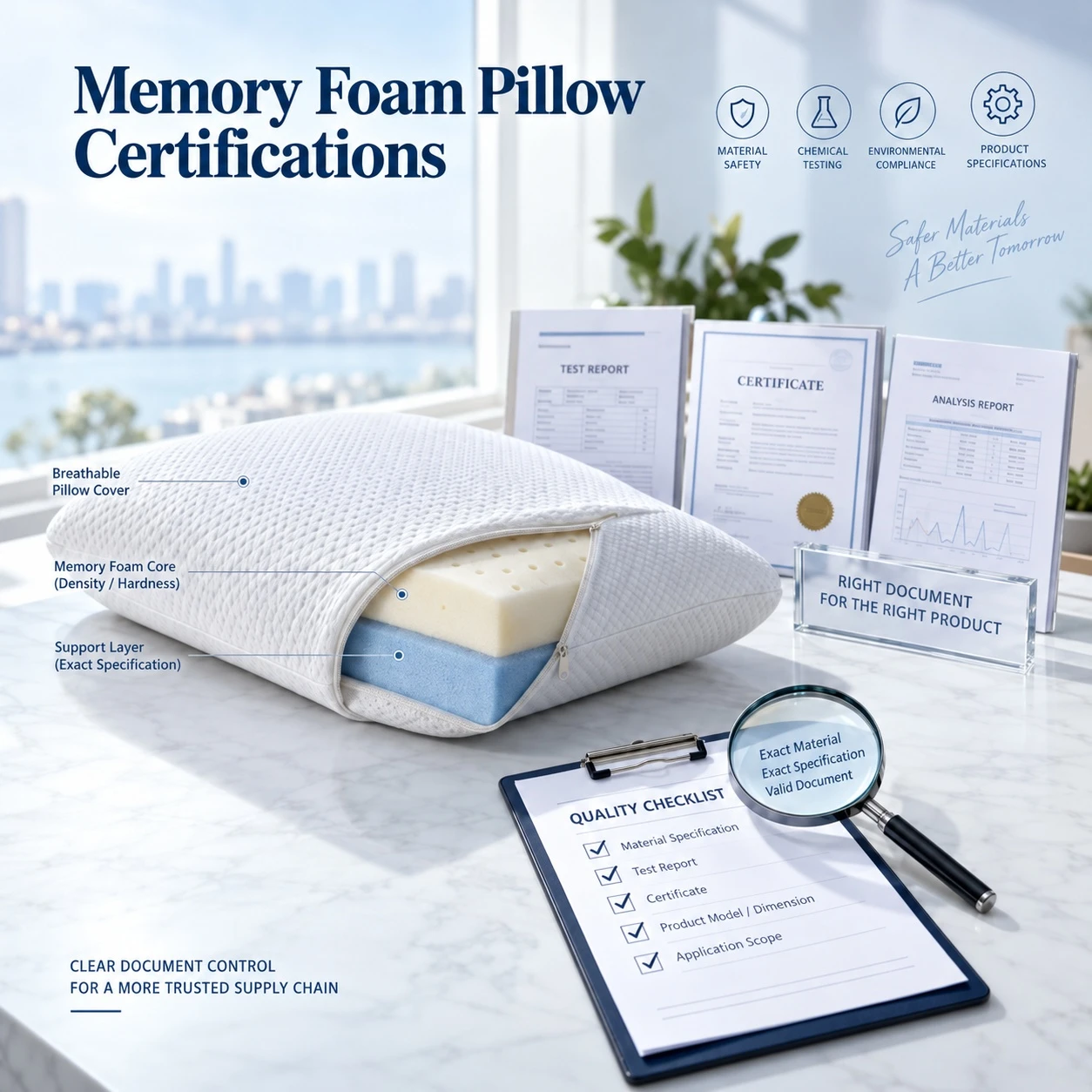
For an OEM memory foam pillow project, certification should therefore be treated as part of product specification and document control-not simply as a collection of logos added to a quotation.https://www.gzmemorypillow.com/memory-foam-pillow
Main Content
1. Start by Separating Foam, Fabric and Finished-Product Documentation
A memory foam pillow is not a single material.
Depending on its construction, it may contain:
- Polyurethane memory foam
- Inner liner
- Knitted or woven outer fabric
- Zipper
- Labels
- Cooling gel
- Adhesives
- Packaging materials
These components may not fall under the same certification or testing scope.
This is where buyers can easily misunderstand supplier documentation.
For example, CertiPUR-US certification applies to flexible polyurethane foam, rather than certifying the complete finished pillow, fabric cover or the company itself. CertiPUR-US explicitly states that its program certifies foam and that companies selling products containing certified foam need the appropriate supply-chain verification and registration to use the program's name and logo.
OEKO-TEX STANDARD 100, meanwhile, is commonly associated with textile and product testing, but buyers still need to check what specific material or product is covered by the document presented.
The practical lesson for procurement teams is simple:
Do not ask only whether the supplier "has OEKO-TEX" or "has CertiPUR-US." Ask what the document actually covers.
2. CertiPUR-US Should Be Checked Against the Foam Supply Chain
CertiPUR-US is frequently mentioned in the memory foam bedding market, especially for mattresses and pillows.
For B2B buyers, however, there is an important detail.
The program certifies qualifying flexible polyurethane foam. CertiPUR-US explains that foam producers are certified and listed, while companies or brands purchasing products containing certified foam must follow its verification and registration requirements before using the CertiPUR-US name and logo in their own marketing.
This matters for private label projects.
Imagine a factory can source CertiPUR-US certified foam for your pillow.
That does not automatically mean your private label brand should download the logo and place it on packaging.
Before making a certification claim, buyers should verify:
- Which foam producer holds the certification
- Whether the selected foam is within the relevant scope
- Whether the supply chain can be verified
- Whether the buyer or brand needs registration
- Whether the proposed packaging claim is permitted
CertiPUR-US itself warns participating companies not to overstate certification claims and provides specific procedures for manufacturers, retailers and brands.
For an OEM buyer, this type of verification should happen before packaging artwork is approved.
Otherwise, a packaging design may need to be changed after the product has already entered production.
3. OEKO-TEX Documentation Should Also Be Checked by Scope
OEKO-TEX is another name buyers frequently encounter when sourcing pillows, mattress covers and home-textile products.
But again, the presence of a certificate should not replace document review.
A memory foam pillow may contain several textile components, and the certificate provided by a supplier may apply to one particular fabric or production scope rather than every component of the finished SKU.
Before relying on the document for your own product listing or customer requirement, confirm:
- Certificate holder
- Certificate number
- Product or material covered
- Validity
- Relevant product class where applicable
- Whether your selected production material matches the certified material
This becomes especially important when a private label project changes the cover.
Suppose Sample A uses one certified knitted fabric, but the buyer later changes to a cooling textile for mass production.
The original document should not simply be assumed to cover the new fabric.
That is why material changes need to be communicated not only to the sampling team but also to whoever manages compliance documentation.
4. A Test Report and a Certification Are Not the Same Thing
Another common sourcing mistake is treating every laboratory document as a "certificate."
A test report normally records the results of specific tests conducted on a submitted sample according to specified methods or requirements.
A certification program may involve a broader set of rules, qualification requirements, ongoing verification or licensing.
Both can be useful, but they answer different questions.
For example, a buyer may need a test report related to:
- Formaldehyde
- pH
- Restricted substances
- Physical performance
- Foam properties
- Fabric characteristics
The appropriate requirement depends on the product, material, destination market and buyer's own compliance program.
Instead of asking:
"Please send all your certificates."
A more effective sourcing request would be:
"Please provide the current documentation applicable to the foam and cover proposed for this SKU."
That gives the supplier a specific task and reduces the chance of receiving unrelated certificates from previous products.
5. Documentation Should Be Confirmed Before the Final Sample
Compliance discussions are sometimes postponed until after product development.
That can create unnecessary work.
Imagine a buyer develops a custom cooling pillow using a specific fabric, approves the sample, finalizes packaging and then discovers that the required documentation is not available for that exact textile.
The buyer may now need to change material and repeat part of the approval process.
A more efficient sequence is:
Step 1 - Define destination market and buyer requirements
Step 2 - Select candidate materials
Step 3 - Review available documentation
Step 4 - Produce and approve the final sample
Step 5 - Confirm packaging claims
Step 6 - Move into mass production
This approach is particularly useful for established brands and retail-chain buyers with internal compliance requirements.
For smaller private label brands, it also helps prevent marketing claims from being created before the supporting documentation has been checked.
Our OEM/ODM development process covers material selection, foam specification, cover development, private labeling and packaging, so document requirements are best discussed while these specifications are still being finalized rather than after production begins.https://www.gzmemorypillow.com/oem-odm-memory-foam-manufacturing
6. Match Documents to the Actual Production Specification
For bulk purchasing, one of the most important principles is traceability between the approved specification and the supporting documents.
Suppose the approved pillow uses:
- Molded memory foam core
- Specific density and firmness
- Cooling knitted outer cover
- Polyester inner liner
- Custom zipper
- Vacuum-compressed packaging
The buyer should know which compliance documents apply to which relevant components.
If the foam formulation changes, the buyer may need to review whether the previous documentation remains applicable.
If the fabric supplier changes, the textile documentation may also need to be reviewed.
This is particularly important for repeat orders.
The product may look identical from the outside while one internal material has changed.
For distributors and retail chains purchasing the same SKU over several years, controlling those changes is part of supplier management.
This is one reason an approved specification sheet and golden sample are valuable. They provide a reference not only for appearance and dimensions but also for the materials that were originally approved.
7. Be Careful With Certification Claims on Packaging and Listings
Certification logos can be commercially valuable, especially in online marketplaces where customers compare product features quickly.
But that makes accurate use even more important.
A brand should not convert:
"The factory can source certified foam."
into:
"Our entire pillow is certified."
unless the applicable program genuinely supports that claim.
CertiPUR-US makes this distinction particularly clear: it certifies flexible polyurethane foam rather than complete pillows or companies, and it controls how participating manufacturers, retailers and brands may use its trademarked name and logo.
For Amazon sellers and private label brands, packaging, product-page graphics and bullet points should therefore be checked against the actual documentation before launch.
This is not simply a legal or compliance issue.
Accurate claims also reduce the risk of disagreements between the brand, supplier, platform and downstream customers.
8. Quality Control Goes Beyond Certification
A certified material does not eliminate the need for production quality control.
Certification and QC serve different purposes.
Even when appropriate materials and documentation have been confirmed, mass production still needs controls for:
- Foam dimensions
- Foam appearance
- Firmness consistency
- Product weight where relevant
- Cover dimensions
- Sewing quality
- Zipper operation
- Logo position
- Labels
- Packaging
- Compression recovery
A certificate cannot tell a buyer whether a production pillow is 2 cm shorter than the approved sample.
Likewise, a laboratory report does not confirm that every zipper has been sewn correctly.
For B2B sourcing, material compliance and manufacturing consistency need to operate together.
This distinction is especially important when comparing suppliers. A factory should not be evaluated only by the number of certification logos displayed on its website. Buyers should also understand how specifications are controlled during production.
Industry Insights
Current B2B pillow sourcing content is increasingly treating certification as a documentation-control issue, rather than simply presenting a row of certification badges.
Recent private label sourcing guides, for example, emphasize checking certificate scope, certificate holder and whether the evidence actually matches the ordered construction.
This is a useful direction for professional buyers.
As OEM products become more customized, a factory may use different foam formulations, cooling fabrics, cover materials and packaging for different customers.
The question is therefore no longer simply:
"Is this a certified factory?"
It is:
"Can the supplier provide appropriate and current documentation for the materials and product specification we intend to purchase?"
That is a much stronger procurement question.
Buyer Considerations
Before confirming a memory foam pillow supplier, B2B buyers should prepare a documentation checklist based on their actual market.
Useful questions include:
- What documentation is required by our customer?
- What testing is required for the destination market?
- Which requirements apply to foam?
- Which apply to textiles?
- Which apply to the finished product?
- Are the documents current?
- Does the certificate holder match the relevant supplier or material?
- Does the selected material match the tested or certified material?
- Are we allowed to use the certification name or logo in our own marketing?
- What happens if a material supplier changes on a repeat order?
These questions are more useful than simply counting how many certificates a manufacturer can send.
They also help buyers compare different memory foam pillow suppliers on the same basis.
Factory Perspective
From a manufacturer's perspective, certification discussions are easiest when the buyer communicates requirements early.
Different customers can have different documentation expectations depending on their destination market, retailer, sales platform and internal compliance procedures.
If those requirements are known before sampling, the factory can consider them during material selection.
If they arrive after the final sample has already been approved, changing a foam or cover material may affect cost, appearance, feel and production lead time.
A reliable memory foam manufacturer should therefore treat documentation as part of the OEM specification rather than a separate sales attachment.
At the same time, buyers should expect precise answers.
If a certificate applies only to a specific foam or textile, that scope should be communicated accurately rather than extending the claim to unrelated components.
For buyers evaluating Jibei as a potential manufacturing partner, our factory information provides additional background on our memory foam product range, production capabilities and OEM/ODM experience.https://www.gzmemorypillow.com/about-us
FAQ
Does CertiPUR-US certify the complete memory foam pillow?
No. CertiPUR-US states that it certifies flexible polyurethane foam, not finished pillows, product lines or companies. Companies and brands using its name or logo also need to follow the program's verification and registration requirements.
Is OEKO-TEX the same as CertiPUR-US?
No. They have different scopes and should not be treated as interchangeable. Buyers should check the exact certificate and determine which material or product it covers.
Should I ask my memory foam pillow supplier for test reports before sampling?
If specific documentation is mandatory for your market or customer, it is better to discuss it before final material approval. This reduces the risk of approving a sample made from a material that later needs to be replaced.
Can I put a certification logo on private label packaging?
Only when the relevant certification program permits your company or brand to make that claim and the actual product/material meets the required scope. For CertiPUR-US specifically, buyers should follow its registration, verification and trademark-use requirements.
Are certifications enough to evaluate a memory foam factory?
No. Buyers should evaluate documentation together with sampling, manufacturing capability, quality control, specification management and repeat-order consistency.
Conclusion
For B2B buyers, memory foam pillow certification should not be reduced to asking a supplier for several PDF files.
The important task is to establish a clear connection between the document, the material and the product being purchased.
CertiPUR-US documentation should be checked against the polyurethane foam and its supply chain. Textile-related documentation should be checked against the actual fabric selected for production. Test reports should be reviewed for their specific scope rather than treated as universal certificates.
Most importantly, these requirements should be discussed before the final product specification is locked.
When certification, material selection, sample approval and quality control are managed together, buyers gain a much clearer picture of what they are actually purchasing-and manufacturers have a more precise standard to follow during bulk and repeat production.
For an OEM or private label project with specific material, testing or documentation requirements, these requirements should be included in the initial project brief before sample development begins.https://www.gzmemorypillow.com/contact-us